Reading a food package can feel confusing when you are trying to choose gluten-free snacks. There are serving sizes, Nutrition Facts, ingredient lists, allergen statements, and different claims on the front of the package. The good news is that you do not need to understand everything at once. Reading food labels becomes much easier when you know what to check first. This guide explains how to read food labels for gluten, identify gluten-containing ingredients, understand a gluten-free label, and use nutrition information to make more informed choices when buying packaged gluten-free foods.
Why Reading Food Labels Matters
The front of a package can tell you a lot, but it does not tell you everything. Reading food labels means looking beyond marketing claims and checking the details that matter. Start with the ingredient list and allergen information, then review the Nutrition Facts label for serving size, calories, added sugars, sodium, saturated fat, fiber, and other nutrients. This is especially useful when choosing gluten-free food labels and packaged snacks because a product may look healthy while its ingredients or nutrition information tell a different story. Learning how to check packaged food labels helps you understand exactly what you are buying and make choices that fit your needs.
How to Read a Food Label Step by Step
You do not need to study every number on a package. Follow a simple order to make checking product labels easier.
1. Start With the Serving Size
First, check the serving size and the number of servings per container. The calories and nutrient amounts listed on the Nutrition Facts label apply to one serving. If you eat two servings, you are getting twice the calories and nutrients shown on the label.
This matters with snacks because one package may contain more than one serving.
2. Check Calories and Key Nutrients
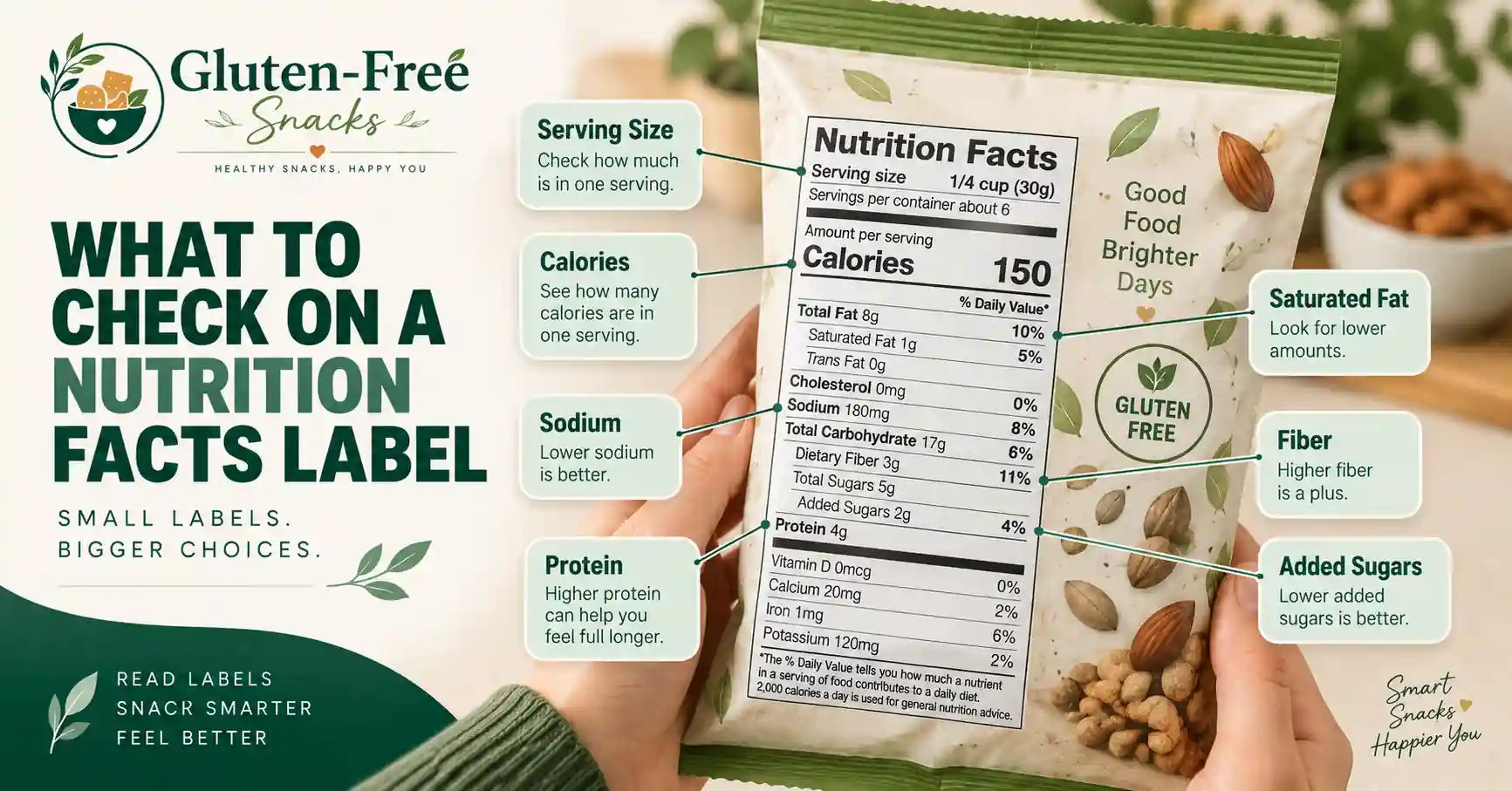
Next, look at calories and the nutrients that matter most for your eating needs. Pay attention to:
- Total fat
- Saturated fat
- Sodium
- Total carbohydrate
- Dietary fiber
- Protein
- Total sugars
- Added sugars
The FDA identifies saturated fat, sodium, and added sugars as nutrients to get less of, while dietary fiber, vitamin D, calcium, iron, and potassium are nutrients consumers may want to get more of.
3. Look at the % Daily Value
The % Daily Value (%DV) shows how much a nutrient in one serving contributes to a daily diet. As a general FDA guide, 5% DV or less is considered low, while 20% DV or more is considered high.
| % Daily Value | General Guide |
| 5% DV or less | Low |
| 20% DV or more | High |
When comparing similar products, make sure their serving sizes are comparable. This makes the Nutrition Facts label much more useful for understanding food labels and choosing between packaged foods.
Check the Ingredient List for Gluten
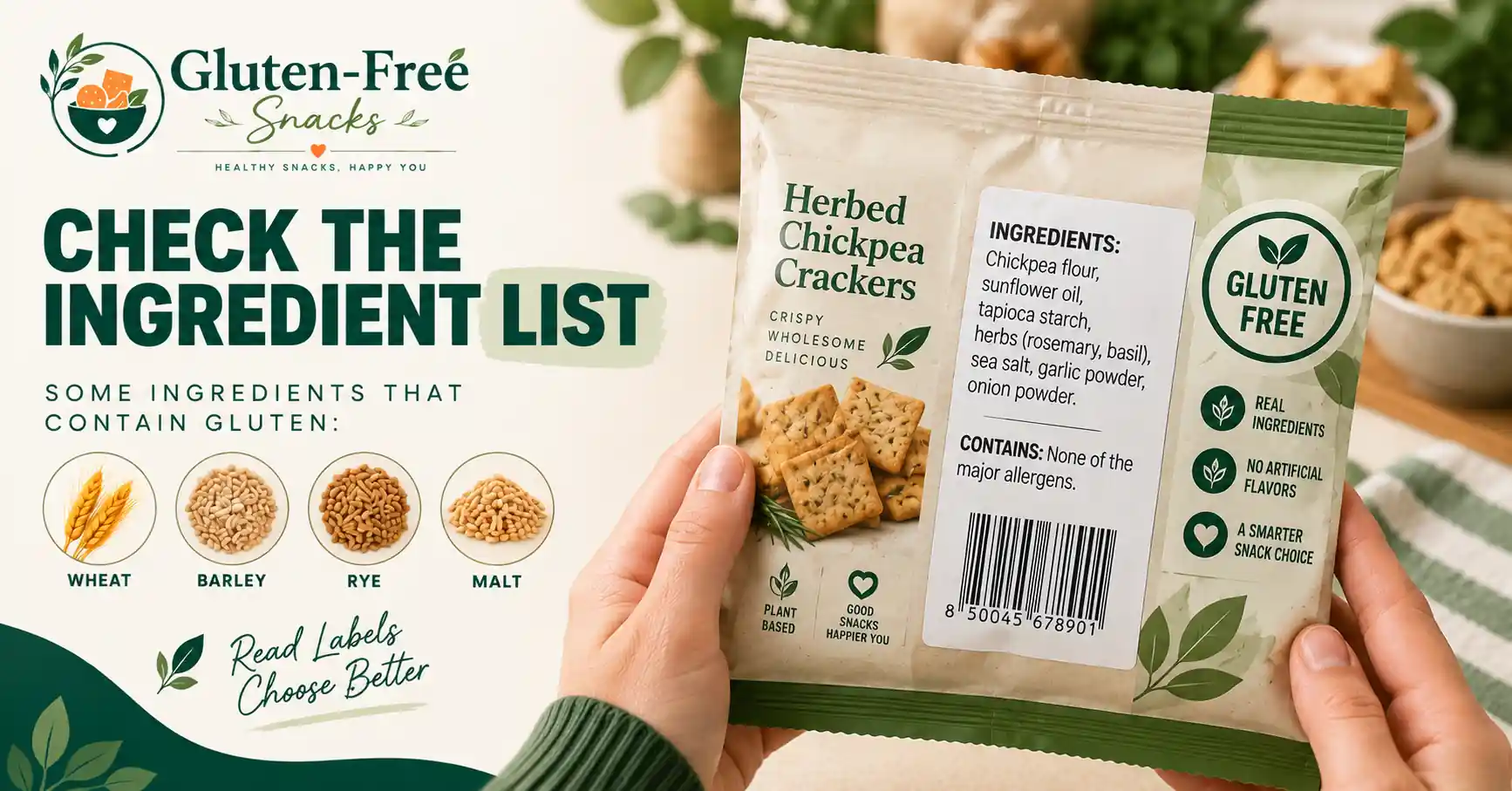
The ingredient list is one of the most important parts of reading food labels when choosing gluten-free foods. Do not rely only on words or pictures on the front of a package. Read the complete list and look for gluten-containing ingredients such as wheat, barley, rye, and triticale. Wheat flour, malt, malt extract, wheat starch, semolina, durum, spelt, farro, and bulgur can also require careful attention.
Ingredient names can vary, so learning common ingredients that contain gluten makes identifying gluten on labels easier. This is especially important for packaged snacks, sauces, cereals, crackers, and other processed foods where hidden gluten may be less obvious. FDA guidance identifies wheat, barley, rye, and crossbred grains such as triticale as sources of gluten.
What Does “Gluten-Free” Mean on a Food Label?
A gluten-free label gives shoppers a specific claim to look for when choosing packaged foods. In the U.S., “gluten-free” is a voluntary claim, but foods using it must meet FDA requirements. This includes containing less than 20 parts per million (ppm) of gluten.
So, what does gluten-free mean on a food label? Under FDA rules, a product making the claim cannot contain a gluten-containing grain such as wheat, barley, rye, or triticale, or certain ingredients derived from them that do not meet the requirements.
Not every food that is naturally gluten-free has to display a gluten-free claim. Naturally gluten-free foods may be sold without that wording on the package.
Simple takeaway: When checking packaged foods, look for the gluten-free claim, but still understand what the label and ingredient information are telling you.
Check the Allergen Statement
The ingredient list tells you what is used to make a food, while the allergen statement gives additional information about major allergens present in the product. In the U.S., wheat is one of the major food allergens and may appear in the ingredient list or in a separate “Contains” statement, such as “Contains Wheat.”
When reading food labels, do not check only one part of the package. Review the complete ingredient list, the Contains statement, and other relevant food allergen information together. This gives you a clearer picture of what is actually in a packaged food.
Watch for Hidden Gluten and Cross-Contact
Not all gluten-related concerns are obvious at first glance. When reading food labels for gluten, pay attention to ingredients and products that may require closer checking, including malt, sauces, seasonings, flavorings, and other processed ingredients. The ingredient list can help with identifying gluten on labels, especially when gluten is not obvious from the product name.
It is also important to understand gluten cross-contact. This happens when a naturally gluten-free food comes into contact with a gluten-containing food during production, storage, or processing. Shared equipment or a shared facility can create opportunities for cross-contact.
A “may contain” or similar advisory statement is different from an ingredient declaration. In the U.S., these advisory statements are voluntary and may be used when there is a potential risk of allergen cross-contact.
If you are unsure about a product’s gluten status, check the manufacturer’s information or contact the manufacturer before buying it.
Gluten-Free vs. Wheat-Free: What’s the Difference?
Wheat-free does not automatically mean gluten-free. Gluten is naturally found in wheat, barley, rye, and crossbred grains such as triticale. That means a product can be labeled wheat-free while still containing another gluten-containing grain.
When comparing wheat-free vs. gluten-free, do not stop at the words “wheat-free.” Read the complete ingredient list and check the product’s gluten-free labeling.
Simple takeaway: If you need to avoid gluten, look beyond wheat and check the full food label for other gluten-containing grains and relevant gluten-free information.
Should You Look for a Gluten-Free Certification?
A gluten-free certification logo can provide additional information when choosing packaged foods and certified gluten-free snacks. Some manufacturers use third-party gluten-free certification programs to verify or communicate that their products meet the program’s standards.
However, certification is not the only thing to check. FDA rules allow manufacturers to use third-party gluten-free certification logos when their use is truthful and not misleading, but the FDA does not endorse, accredit, or recommend any particular certification program.
When reading food labels, still check the ingredient list, allergen information, and gluten-free claim rather than relying on a logo alone.
How to Read Labels on Gluten-Free Snacks
When choosing packaged gluten-free snacks, use the label from front to back. Start with the gluten-free claim, then read the ingredient list and allergen information. After that, check the Nutrition Facts label for serving size, added sugars, sodium, fiber, and other nutrients. This approach works for granola bars, crackers, chips, cookies, cereal, snack mixes, and flavored nuts.
A simple order to follow is:
Front of package → gluten-free claim → ingredient list → allergen statement → Nutrition Facts → certification or cross-contact information
Do not assume a snack is a good choice just because the front says “healthy” or highlights one positive feature. Gluten-free snack labels still need a closer look at ingredients and nutrition information.
Common Food Label Reading Mistakes
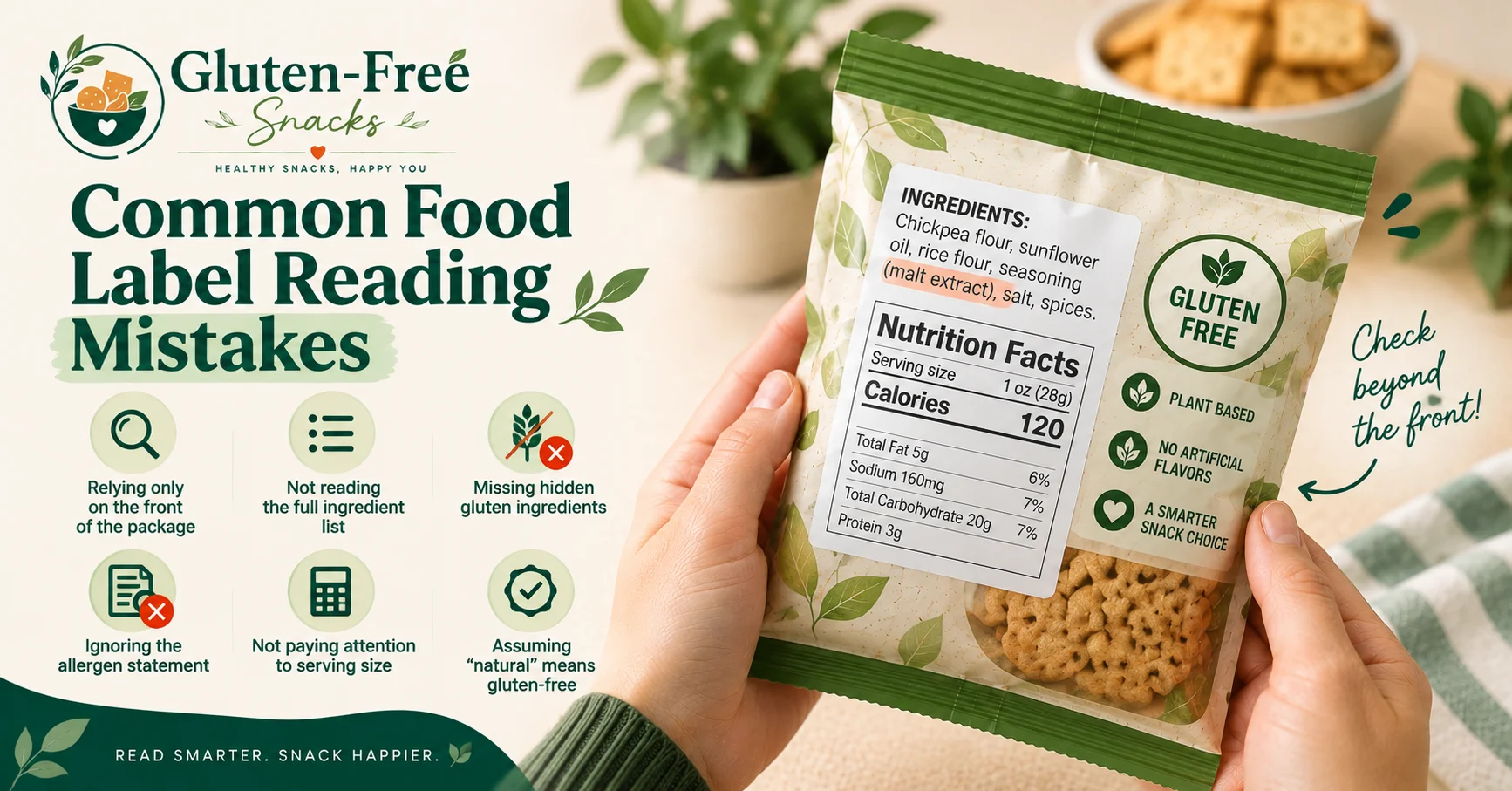
Even experienced shoppers can miss important details when reading food labels. These are some common mistakes to avoid:
- Only reading the front of the package: Marketing claims do not replace the ingredient list or Nutrition Facts label.
- Ignoring serving size: A small snack package may contain more than one serving, so check the serving information first.
- Looking only for the word “wheat”: Gluten can also come from barley, rye, and triticale.
- Assuming wheat-free means gluten-free: These terms do not mean the same thing.
- Ignoring the ingredient list: Important ingredients may not be obvious from the product name or front label.
- Forgetting allergen information: Check the relevant allergen or “Contains” statement along with the ingredients.
- Assuming every product from a gluten-free brand is gluten-free: Check the label of the specific product you are buying.
- Treating every “may contain” statement the same way: Advisory statements can provide information about potential cross-contact, but they are different from ingredients that are actually included in the product.
A Simple Gluten-Free Food Label Checklist
Before buying a packaged snack, take a quick look at the label from top to bottom. This simple gluten-free food label checklist can make grocery shopping easier:
- ☐ Serving size and servings per container
- ☐ Calories and key nutrients
- ☐ Gluten-free claim
- ☐ Complete ingredient list
- ☐ Wheat, barley, rye, or triticale
- ☐ Malt and other less-obvious ingredients
- ☐ Allergen or “Contains” statement
- ☐ Cross-contact or precautionary information
- ☐ Gluten-free certification logo, if present
- ☐ Manufacturer information if you are still unsure
Checking these details together gives you a clearer picture of a packaged food. FDA guidance also recommends scrutinizing labels and ingredient information when determining whether a product is gluten-free.
Final Thoughts
Reading food labels gets easier once you know what to look for. Start with the serving size, then review the Nutrition Facts label, complete ingredient list, gluten-free claim, and allergen information. Watch for gluten-containing grains and less-obvious ingredients, and check additional product information when needed. With a little practice, understanding gluten-free food labels becomes a simple part of grocery shopping. Once you know what to look for, choosing packaged gluten-free snacks becomes much easier.
FAQs About Reading Food Labels
Start with the serving size and Nutrition Facts label. Then read the complete ingredient list, check allergen information, and look for a clear gluten-free claim when choosing packaged foods.
Check the gluten-free claim, then read the entire ingredient list for wheat, barley, rye, triticale, and other gluten-related ingredients. Also review the allergen and cross-contact information when provided.
Common gluten-containing grains include wheat, barley, rye, and triticale. Ingredients derived from these grains may also require careful checking, depending on how they are processed.
No. Wheat-free does not automatically mean gluten-free. Gluten is also associated with barley, rye, and triticale, so check the complete label rather than looking only for wheat.
In the U.S., “gluten-free” is a voluntary claim that must meet FDA requirements. Foods carrying the claim must contain less than 20 parts per million (ppm) of gluten
Check for a gluten-free claim, read the complete ingredient list, and review the allergen information. If you are still unsure, use the manufacturer’s information or contact the manufacturer.
A “may contain” statement is a voluntary advisory that can indicate a potential risk of unintended allergen presence from cross-contact. It is different from wheat being intentionally included as an ingredient.
A third-party certification logo can provide additional information, but it is not the only thing to check. FDA allows qualifying certification logos but does not endorse a particular certification program.